Code becomes relation
From Spectators to Co-Creators: Designing Social XR with Generative AI
Timothi Lim
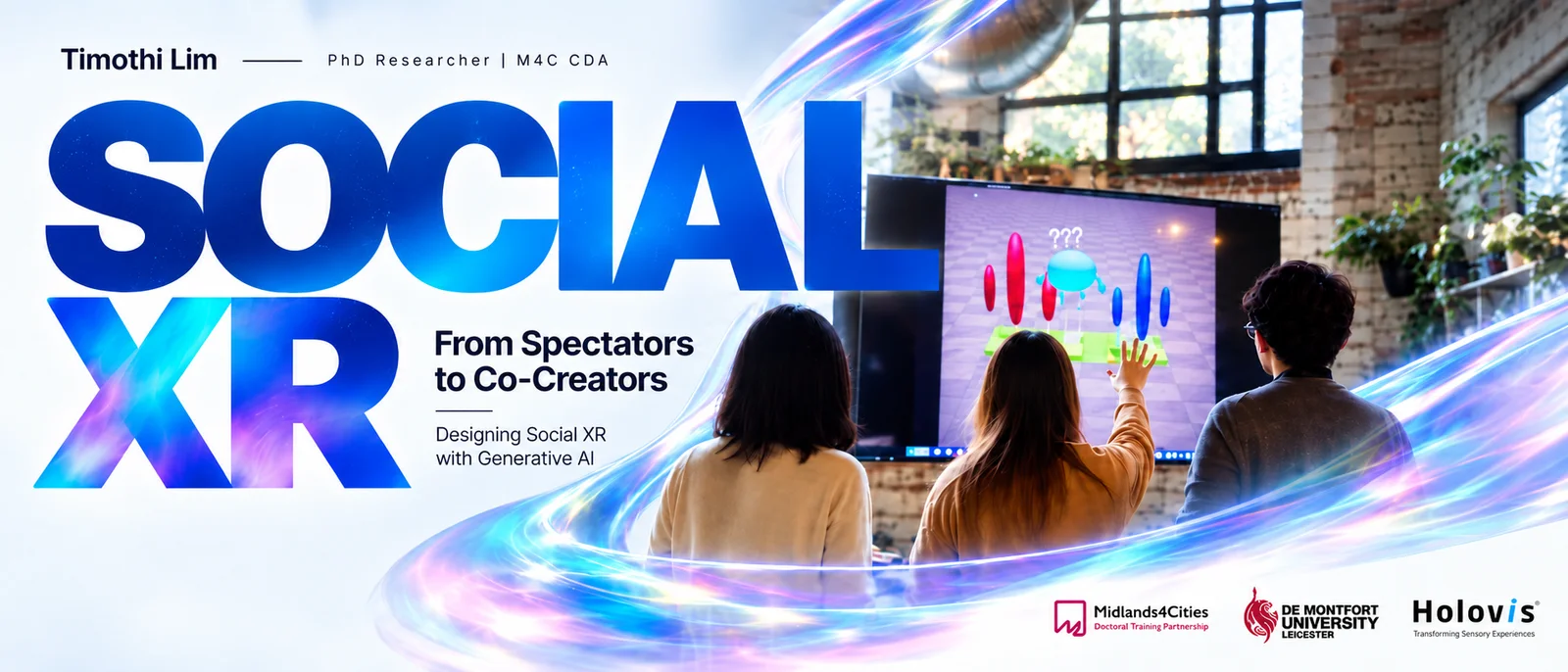
A headset-free, room-scale interactive XR installation where small groups use movement, light, sound and GenAI-driven cues to turn passive spectatorship into shared cooperative play.
Your shortlist stays in this browser. Saving is not a booking.
Select the address and use your browser’s copy command.
What you’ll do
Step into a clearly marked interaction area in a group of 2 to 4 people. Face a shared display or projection and respond to changing audiovisual cues. Move, cluster, separate, wait, step into zones or coordinate with others to progress. Discover the rules through play rather than by reading a long instruction sheet.
About the project
What happens when an immersive artwork does not just ask you to watch, but asks you to work things out with strangers? Social XR is an interactive installation by Timothi Lim that explores how Extended Reality (XR) and generative AI can help people cooperate in shared physical spaces. Participants step into a tracked interaction area and respond to audiovisual cues - such as light, sound, symbols and spatial prompts - that adapt to how the group moves together. There are no headsets, handheld controllers or wearable sensors. Instead, the room itself becomes the interface.
The project asks a simple public question: can emerging technology bring people together rather than isolate them? Through playful spatial puzzles, Social XR studies the moment audiences stop being spectators and begin acting as co-creators of a shared experience.
Behind the work
I built the installation as a room-scale Social XR experiment in which participants use their bodies to interact with a shared digital puzzle. Movement is tracked through depth-sensing cameras, processed in TouchDesigner, and sent into Unreal Engine, where participants’ positions and actions affect the virtual environment in real time. A nonverbal GenAI facilitator can respond through visual and spatial cues rather than dialogue, leaving participants to interpret what the system is doing and negotiate what to do together. The work is deliberately ambiguous. Instead of providing a conventional tutorial, it creates space for hesitation, imitation, experimentation, misunderstanding, and eventually coordination.
Watch more
Watch the project video ↗Opens the contributor’s chosen video website. Playback starts there.