Code becomes relation
Where a tool ends and a ritual begins...
Atsushi Yang
Where does an object end and a ritual begin? Discover how ordinary tools carry hidden meaning — in archery, tea, and the marks we leave on a page.
Your shortlist stays in this browser. Saving is not a booking.
Select the address and use your browser’s copy command.
What you’ll do
Visitors are invited to look closely at the objects on display, watch the screen, and consider where use ends and meaning begins.
About the project
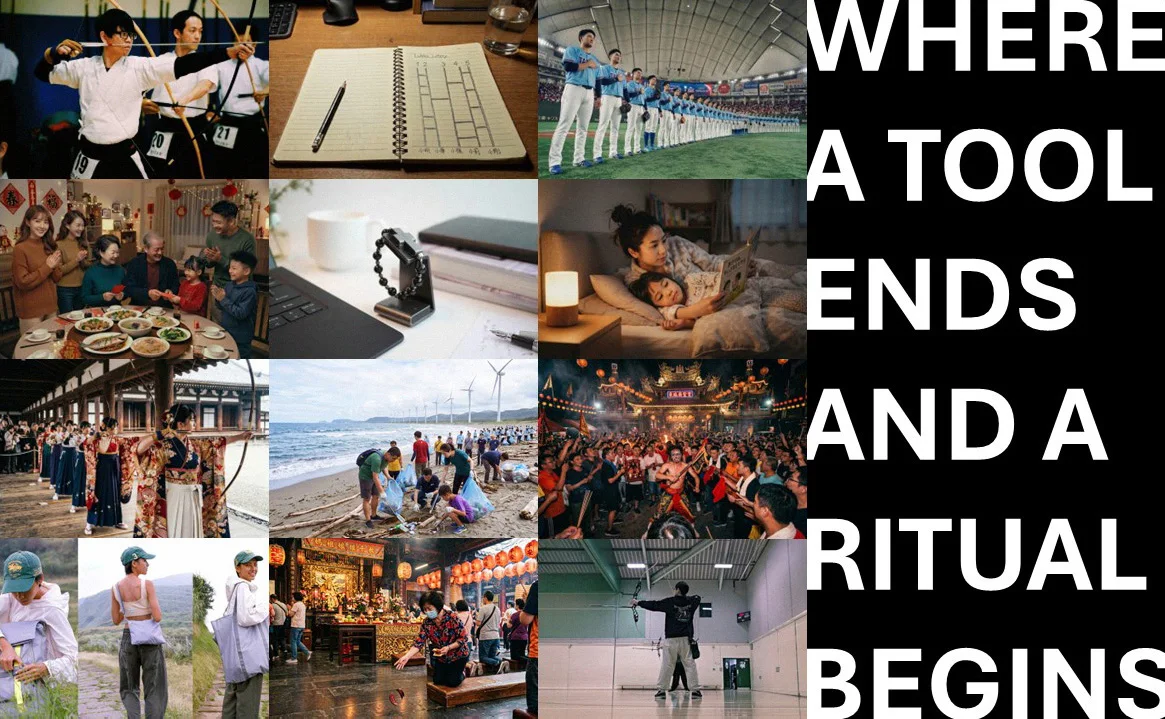
Every tool has a job. A mug carries a moment of pause. A notebook holds what has passed and reaches toward what might come. A bow launches an arrow. But look closer at the moments surrounding these acts — the teabag hung just so on the rim, the first mark drawn before writing begins, the slow drawing of a bow before release — and something shifts, as meaning settles into the gesture and changes its weight. The object's nature hasn't changed. The function hasn't changed. Yet the action feels different: measured, repeated, charged with a meaning that exceeds mere use.
Where a Tool Ends and a Ritual Begins sits with that shift.
This work is the opening inquiry of a design research project exploring what makes certain everyday activities sustaining rather than simply useful. A ritual, as used here, is not a ceremony or religious act — it is a repeated, embodied action that a person loads with personal meaning, one that marks time, focuses attention, or quietly declares who they are. Tools and rituals are not opposites. They are neighbours, and the boundary between them is not fixed.
The objects on display are chosen to make that boundary visible. In each pair, near-identical gestures carry vastly different weights. One pair is casual and improvised. The other is deliberate and inherited. Yet the ritual object in each pair does something more than the tool beside it.
The question this exhibition sits with is a design question: if the same gesture can be tool-use or ritual depending on context and intention, what does that mean for how we design the objects and systems people live with every day?
Behind the work
This exhibition grows out of the early stages of a practice-based PhD exploring design for everyday wellbeing. Reflections on the distinction between "tools" and "rituals" did not begin with theory, but rather from observation—noticing that certain objects and actions in daily life carry a weight that cannot be explained by "function" alone. The pairings on display are early thinking made visible: keeping the question open before moving toward answers.